StockX's fee-free days: 78% more sales, and the same shoes about 5% cheaper
Fifteen times since late 2024, StockX waived seller fees for a day. Every time, sales jumped and prices on the same shoes fell. Here's the data, and what it means if you buy or sell.
Every month or so, StockX sends the same email: "100% Off Seller Fees for 24 Hours." For one day, sellers keep the whole sale price instead of losing roughly 12% to fees. The night before, another email tells buyers to get their bids in early.
We found 15 of these events between December 2024 and September 2026 in StockX's own promotional emails, which state the exact window, usually noon to noon Eastern time. Then we checked what happened to sales and prices during each one.
The answer is the same every time: far more sales, at lower prices on the same shoes.
Sales jump about 75%, every single time
For each event, we compared StockX sales in the promo window with the same hours one week before and one week after. Same weekday, same time of day. On average, StockX sales were 75% higher during fee-free windows (95% interval +63% to +89%). Sales rose in all 15 events.
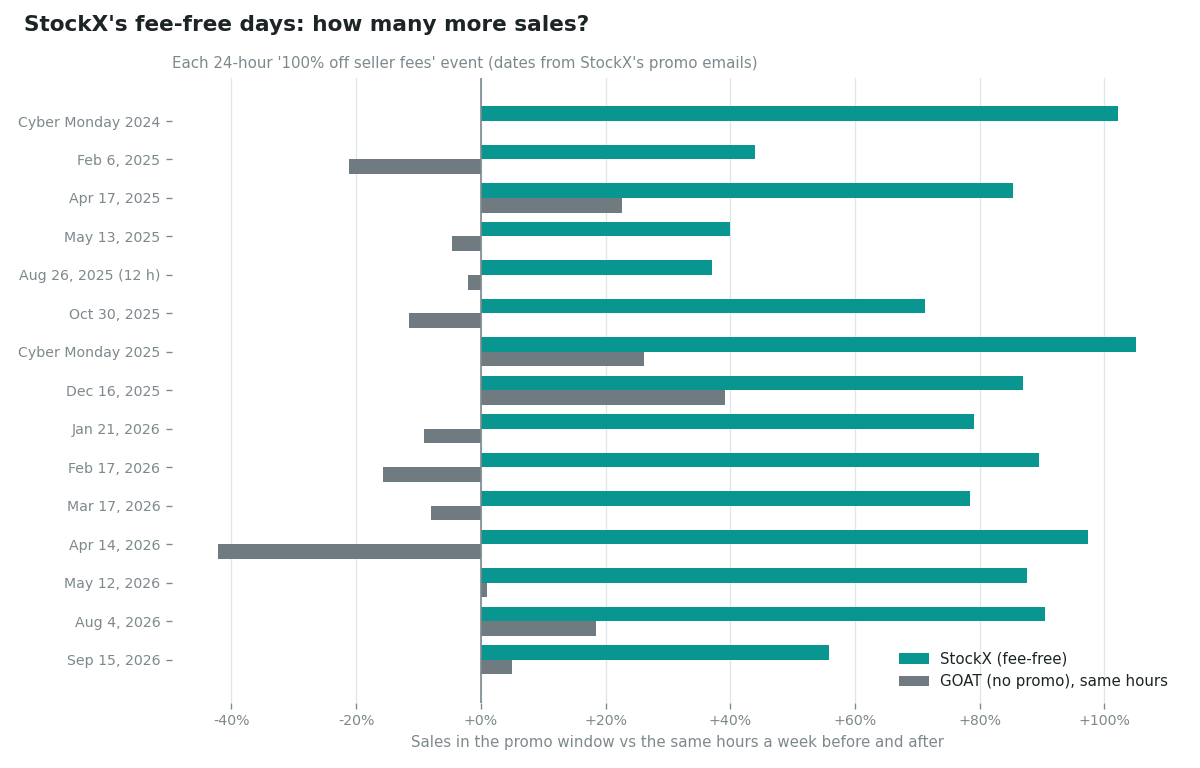
To rule out a market-wide effect, we looked at GOAT over exactly the same hours. Outside the two Cyber Mondays, GOAT ran no promotion in these windows that we know of, and its sales moved -2% on average (95% interval -14% to +11%), with no consistent direction. Measured against GOAT, the fee-free effect comes to about +78% (95% interval +55% to +104%).
The extra sales don't seem to be borrowed from the following week either. Sales in the week after an event ran 6% above the week before on average, and dipped in only 5 of 14 cases. Measured against the week before alone, the jump is +81%.
The same shoes sell for about 5% less
Here is the part buyers should care about. We compared each shoe's median sale price in the promo window with its own median in the surrounding weeks, for every product with at least three sales in both.
On fee-free days, the same pair sold for 4.5% less on StockX. It happened in all 15 events. On GOAT, over the same hours, prices didn't move.
| Event | StockX sales vs normal | Same-shoe price | GOAT sales, same hours |
|---|---|---|---|
| Cyber Monday 2024 | +102% | -4.0% | n/a |
| Feb 6, 2025 | +44% | -0.3% | -21% |
| Apr 17, 2025 | +85% | -6.1% | +23% |
| May 13, 2025 | +40% | -5.7% | -5% |
| Aug 26, 2025 (12 hours) | +37% | -4.1% | -2% |
| Oct 30, 2025 | +71% | -3.7% | -12% |
| Cyber Monday 2025 | +105% | -3.7% | +26% |
| Dec 16, 2025 | +87% | -1.9% | +39% |
| Jan 21, 2026 | +79% | -6.3% | -9% |
| Feb 17, 2026 | +90% | -6.6% | -16% |
| Mar 17, 2026 | +79% | -3.7% | -8% |
| Apr 14, 2026 | +97% | -4.7% | -42% |
| May 12, 2026 | +88% | -5.1% | +1% |
| Aug 4, 2026 | +91% | -5.0% | +19% |
| Sep 15, 2026 | +56% | -6.7% | +5% |
Across all 15, the same shoes sold for 4.5% less (95% interval -5.5% to -3.6%). On GOAT the average move was +0.1%. The chance of prices falling in all 15 events if the promotion did nothing is about 1 in 16,000.
Why prices fall when fees disappear
The fee waiver goes to sellers, but they pass part of it to buyers. A StockX Level 1 seller normally pays a 9% transaction fee and a 3% processing fee, so a $200 sale pays out about $176. On a fee-free day, the same seller can drop the price 4.5% to about $191 and still take home $191, about $15 more than usual. Asks come down, bids placed the night before get filled, and more pairs change hands at slightly lower prices.
What it means for you
- Buying on StockX: fee-free days have been the cheapest days to buy the same shoe, by about 4.5% on average. That's roughly $9 on a $200 pair, more on pricier ones. In 2026 they have come roughly monthly, usually on a Tuesday at noon Eastern. StockX emails when it starts, and sends a "Bid Now" email the night before. The past pattern is no promise of future dates.
- Selling on StockX: you net more on these days even after matching the lower prices, because the fee saving (about 12%) is bigger than the price drop (about 4.5%).
- Comparing platforms: on a fee-free day, StockX's lower prices and your fee-free payout both change the StockX-vs-GOAT math. Our StockX or GOAT tool uses normal fees, so treat its StockX side as conservative on those days. The fee calculator shows the normal payout for comparison.
How we measured this
Methodology: StockX and GOAT sales recorded via kicks.dev. Event windows come from StockX promotional emails, whose terms give the window, for example "valid sales made between 9/15/2026 at 12:00 PM EDT and 9/16/2026 at 12:00 PM EDT." Cyber Mondays 2024 and 2025 ran the full Eastern day. The August 26, 2025 event lasted 12 hours from an unstated start; we used the email's send time (1:30 PM ET). Two events are excluded: October 31, 2024, when our StockX records had just started, and a Pop Mart-only fee waiver on August 13, 2025. In recent events the terms exclude Flex (Xpress) and, in 2026, Verified Seller sales, which our data can't separate. Baseline: the same clock window 7 days before and 7 days after, or before only for September 15, 2026, whose following week isn't fully loaded yet. Price effect per event: the median, across products with 3+ sales in both the event and baseline windows, of log(event median / baseline median). Between 603 and 2,789 products per event. Across events: mean of log effects with t-based 95% intervals, exact two-sided sign tests, and Benjamini-Hochberg correction across the two headline tests (both q < 0.001). GOAT ran its own Black Friday / Cyber Week promotions around both Cyber Mondays, so GOAT is a weaker control for those two events; we know of no GOAT promotion in the other windows. GOAT's Cyber Monday 2024 baseline is missing because our GOAT records start in December 2024.