Does cold weather sell boots? Two years of US temperatures vs. resale
Yes. When a week turns 10°F colder, boots take about 14% more of the resale market. Cold that's unusual for the time of year seems to help too, but less clearly. Slides barely react.
Every fall, the resale market acts as if everyone learned at once that winter is coming. Timberland 6-inch boots and UGG Tasmans take over the best-seller lists, and by spring they're gone again. The obvious explanation is the weather. But the holidays arrive at the same time, so is it really the cold?
We checked. We lined up 100 weeks of GOAT and StockX resale, more than 23 million pairs, with the weekly temperature across ten of the largest US metros.
The answer is yes, cold weather sells boots, and not only because winter and the holidays fall together. When a week gets colder, boots' share of resale goes up. Cold that's unusual for the time of year points the same way, though that part of the evidence is thinner.
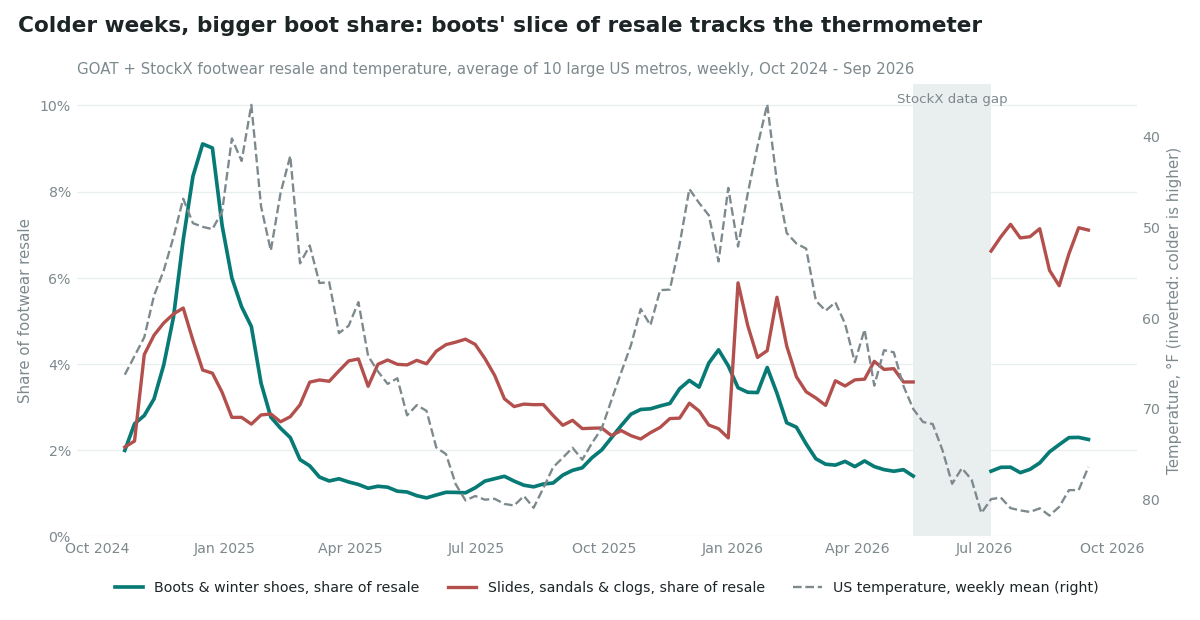
Every 10°F colder, boots gain about 14% of the market
Our product coverage has grown over the two years, so counting pairs would mostly measure our own growth. Instead we ask what slice of all sneaker resale each week went to boots and winter shoes: Timberland, UGG, Gore-Tex and other weatherproof shoes, Nike ACG and similar.
We also compare week-to-week changes, not levels. Any two seasonal things look related side by side. Changes are a stricter test: did the weeks that got colder than the week before also get more boot-heavy than the week before?
They did. The correlation between the change in temperature and the change in boots' share is -0.42 (95% range -0.59 to -0.23), where 0 means no relationship and -1 means perfect. In plain terms:
Every week that turns 10°F colder than the last, boots' share of resale rises by about 14%.
That estimate is 13.6%, with a 95% range of 4.9% to 21.8%. Since boots run between about 1% and 9% of the market, a 14% increase lifts a 3% share to about 3.4%. It survives the correction for running 12 tests at once, with room to spare (q < 0.001, where anything under 0.05 counts as a real finding).
The seasonal picture in plain numbers:
| Weekly US temperature | Weeks | Boots' share | Slides' share |
|---|---|---|---|
| Below 40°F | 2 | 4.39% | 3.46% |
| 40-50°F | 16 | 4.79% | 3.48% |
| 50-60°F | 21 | 2.66% | 3.53% |
| 60-70°F | 21 | 1.70% | 3.51% |
| 70-80°F | 21 | 1.39% | 4.00% |
| 80°F and above | 11 | 1.44% | 4.96% |
Boots' share more than triples between a 70°F week and a 45°F week.
Unusual cold seems to help too, but less clearly
The obvious objection: the cold weeks are also the holiday weeks. December is gift season, and UGG boots are a gift. Boots' share actually peaked in the week of December 16, 2024, at 9.1%, when it wasn't especially cold (50.0°F), well before the coldest weeks of January. Some of what looks like "weather" is really the calendar.
To separate the two, we compared each week's temperature with its 30-year normal for that date and looked only at the difference: how much colder or warmer than usual it was. A cold snap in late January, like the week of January 20, 2025 (7.8°F below normal), has nothing to do with Christmas shopping.
The link is smaller here. When a week turns colder relative to normal, boots' share tends to rise: the correlation is -0.24 (95% range -0.43 to -0.04), and it passes the multiple-testing check (q = 0.04). The size is less certain. A 10°F colder-than-normal swing comes with about 8.3% more boot share, but the 95% range runs from -0.7% to 16.7%, so it includes zero.
Putting both in one model makes the split clear. Most of boots' swing follows the seasonal calendar, holidays included. The weather itself probably adds a smaller part on top, but we can't pin down how much.
Slides only half mirror it
You'd expect slides and sandals to do the opposite, and at the extremes they do. In the 11 weeks at 80°F or hotter, slides took 4.96% of resale, against about 3.5% to 4% in cooler weeks.
But week to week, the mirror image is weak. The correlation between temperature changes and slides' share changes is +0.18 (95% range -0.03 to +0.37), and it doesn't pass the multiple-testing check (q = 0.11). The colder-than-normal version is similar (+0.23, q = 0.07). Slides also jumped in December 2025, in the cold, which muddies any weather signal.
One split is worth noting: on GOAT alone, slides do track temperature (+0.29, q = 0.04), while on StockX they don't. Boots' link is strongest on StockX (-0.43) and weaker on GOAT alone, where it doesn't pass testing (-0.19, q = 0.11).
What this means for buyers and sellers
Boots don't run on the calendar alone. On the resale market they're partly a weather product: the first real cold week of the season shifts sales toward boots and winter shoes. The biggest swing still comes from the season as a whole, holidays included, and cold snaps outside the usual pattern add less, less reliably.
Slides are less tied to the thermometer than you might think. They sell all year, and the slides and comfort shoes list stays busy even in December. For what any specific pair is selling for this week, use the price checker.
What this can't show: that the weather causes any single sale, how it plays out city by city (we don't know where buyers live), or what next winter will look like.
How we measured this
Methodology: Resale from completed GOAT and StockX sales recorded by SneakerPulse, footwear only, weeks starting Monday from October 21, 2024 to September 14, 2026 (GOAT coverage begins in late December 2024; the most recent days are still loading and were left out). Boots and winter shoes were matched by name (Timberland, UGG, "boot", Gore-Tex/GTX, Nike ACG), excluding UGG sneakers and flats, slides, apparel and non-Gore-Tex Salomon XT-6. Slides, sandals and clogs were matched by name (slides, Foam Runner, clogs, Crocs, Birkenstock, YS-01, mules, sandals, Adilette), excluding UGG slippers and the closed Birkenstock Boston. Each group's share is its sales divided by all footwear sales that week. Temperature: daily mean 2 m temperature from the Open-Meteo historical archive for New York, Los Angeles, Chicago, Dallas, Houston, Atlanta, Philadelphia, Miami, Phoenix and Seattle, averaged with equal weight for each metro. Normals are 1991-2020 same-date averages (±7 days) from the same archive. Tests compare week-over-week temperature changes (°F) with log changes in share, never levels. p-values use an effective sample size that accounts for autocorrelation, with 95% correlation ranges from Fisher's z. Effect sizes come from a regression of share changes on temperature changes, with 95% ranges from a 4-week block bootstrap (5,000 draws). Benjamini-Hochberg correction covers all 12 correlations reported here (combined, StockX-only and GOAT-only, each for boots and slides against raw and colder-than-normal temperature). Our StockX source is missing most best sellers from May 22 to July 3, 2026, so changes touching those weeks were excluded, as was the partial week GOAT coverage began. Past data, not a forecast, and not buying advice.