Is LEGO a good investment? What two years of StockX resale data shows
The same sealed LEGO sets sold for a median 19% more on StockX this spring and summer than a year earlier, and 133 of 148 went up. Most sneakers were flat. What the data cannot tell you is how far any of that sits above retail.
Every few months someone posts the chart: a sealed LEGO set bought at the store, sold years later for double. LEGO, the story goes, beats the stock market. It is a good story. It is also built almost entirely from the sets that worked.
We can't settle the whole argument, but we can check one part of it with real sales. Over the last six months, the same sealed LEGO sets sold for a median 19% more on StockX than in the same six months of 2025. Of 148 sets that sold at least ten times in both periods and changed price, 133 went up.
That is unusual. On the same test, most sneaker lines barely moved and Air Jordans slipped.
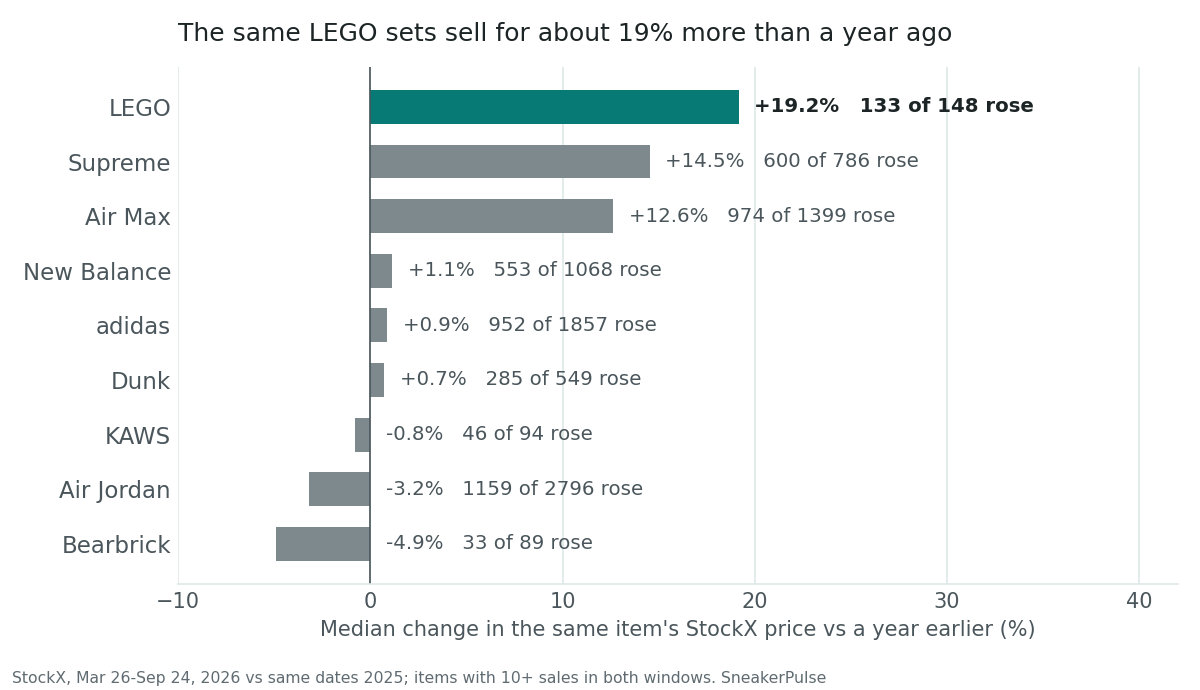
Nearly every set that trades regularly got more expensive
Comparing average prices across years is misleading, because the mix of sets changes. So we compared each set with itself: its median StockX price from March 26 to September 24, 2026, against its median over the same dates in 2025.
The typical set rose 19.2% (95% interval 16.8% to 21.1%). Nine in ten rose (interval 84% to 94%), far from the coin flip you would expect if prices were drifting at random. Seventy-one sets rose by 20% or more; one fell by that much.
A second check points the same way. Comparing the 2025 holiday season (November through January) with the one before, the same sets rose a median 30.7%, and 143 of 153 went up.
On StockX, a LEGO set that sold for $100 a year ago typically sold for about $119 this summer.
This is not StockX prices rising across the board. The same comparison on the rest of the site's StockX catalog was mixed: Supreme and Air Max rose, adidas, New Balance and Dunks were close to flat, and Air Jordans, KAWS and Bearbrick figures slipped.
The biggest risers are licensed display sets
The largest gains came from big display sets tied to films and TV. These are the biggest same-set rises among sets with at least 15 sales in each period:
| Set | Median, 2025 | Median, 2026 | Change |
|---|---|---|---|
| Marvel Infinity Saga Nano Gauntlet (76223) | $84 | $156 | +86% |
| Icons NASA Artemis Space Launch System (10341) | $203 | $361 | +78% |
| Stranger Things The Upside Down (75810) | $450 | $793 | +76% |
| Batman: The Animated Series Gotham City (76271) | $247.50 | $434 | +75% |
| Marvel Sanctum Sanctorum (76218) | $264 | $450 | +70% |
| Marvel X-Men: The X-Mansion (76294) | $260 | $417 | +60% |
| Ghostbusters Ecto-1 (10274) | $211 | $330 | +56% |
| Harry Potter Gringotts Wizarding Bank (76417) | $340 | $521 | +53% |
Marvel stood out as a group: all nine Marvel sets in the comparison rose, by a median of 52%. Star Wars sets rose a more modest 16%, and Creator sets 10%.
The Gringotts bank is also the most traded LEGO set on StockX by a wide margin: 460 sales in the last six months, at a median of $521.
Some sets went the other way
Fifteen sets fell. The clearest was the LEGO Nike Dunk (43008), a sneaker-culture set that sold 368 times in the 2025 window at a median of $129, and 53 times in 2026 at $75, down 42%. The Simpsons Kwik-E Mart (71016) fell 14%, from $752 to $645, and the Transformers Optimus Prime (10302) 12%.
The Dunk set is the useful warning. Hype that looks like demand for LEGO can be demand for something else.
What this data cannot tell you
It says nothing about retail. Our StockX records carry no retail price for LEGO sets, so we can't tell you which sets resell furthest above what LEGO charged, or whether a buyer at retail came out ahead. A 19% rise on resale is a change between two resale prices, not a return on a store purchase.
It only sees sets people bother to resell. We track 1,496 LEGO sets with StockX sales, but only 149 sold ten or more times in both windows. Sets nobody wants to flip, or that sell below retail, rarely show up at all. That tilts any "LEGO goes up" picture toward winners.
Sale prices are not what a seller keeps. Marketplace fees and shipping come out of every sale, and sealed boxes take space and need to stay in good condition for years. Run your own numbers through our resale fee calculator before comparing a sale price with anything.
It is one year, on one marketplace, and it says nothing about the next. We can't tell from sales alone why prices rose: sets retiring, LEGO raising its own prices, and more buyers on StockX could all push the same way.
What it means if you are buying or selling
If you are selling a sealed set you already own, the last year has been a better time for LEGO on StockX than for most sneakers, especially large licensed display sets. If you are buying one to build, most sets that trade often cost more on resale than they did a year ago. Neither is a forecast, and none of it is investment advice.
You can see current resale averages for LEGO sets alongside trading cards and other collectibles on our collectibles page.
How we measured this
Methodology: completed StockX sales recorded by SneakerPulse in the LEGO category, October 23, 2024 to September 24, 2026 (53,833 sales across 1,496 sets; sales between $0 and $30,000, whole UTC days). StockX sells new, sealed items only. Same-set change compares each set's median sale price from March 26 to September 24, 2026 with its median over the same dates of 2025, for sets with at least 10 sales in each window (149 sets; one unchanged). The interval on the median change is a 2,000-draw bootstrap over sets; the rose/fell split uses an exact binomial test against 50% with a Wilson interval, and Benjamini-Hochberg correction across the two comparisons (this one and holiday 2025 vs holiday 2024, November 1 to January 31). The table lists the largest rises among sets with 15+ sales in both windows. Themes come from the set name. Other categories use the same rules on StockX's own category labels. Our product coverage grows over time, so sales counts are not a measure of demand. No retail prices are recorded for these sets.