How to tell what year your Jordans are from, and how much the year changes the price
Check the tag in the tongue for the style code, then search it with the year. In 14 re-released colorways the older pair sold within about 10% of the new one in 9; the Jordan 4 Black Cat 2020 was the one big exception.
You have a pair of Jordans from a closet, a garage sale or a cousin. You search the name, and the results are a mix of prices, because the same colorway has come out more than once. Is yours the 2016 pair, the 2019 pair, or last year's?


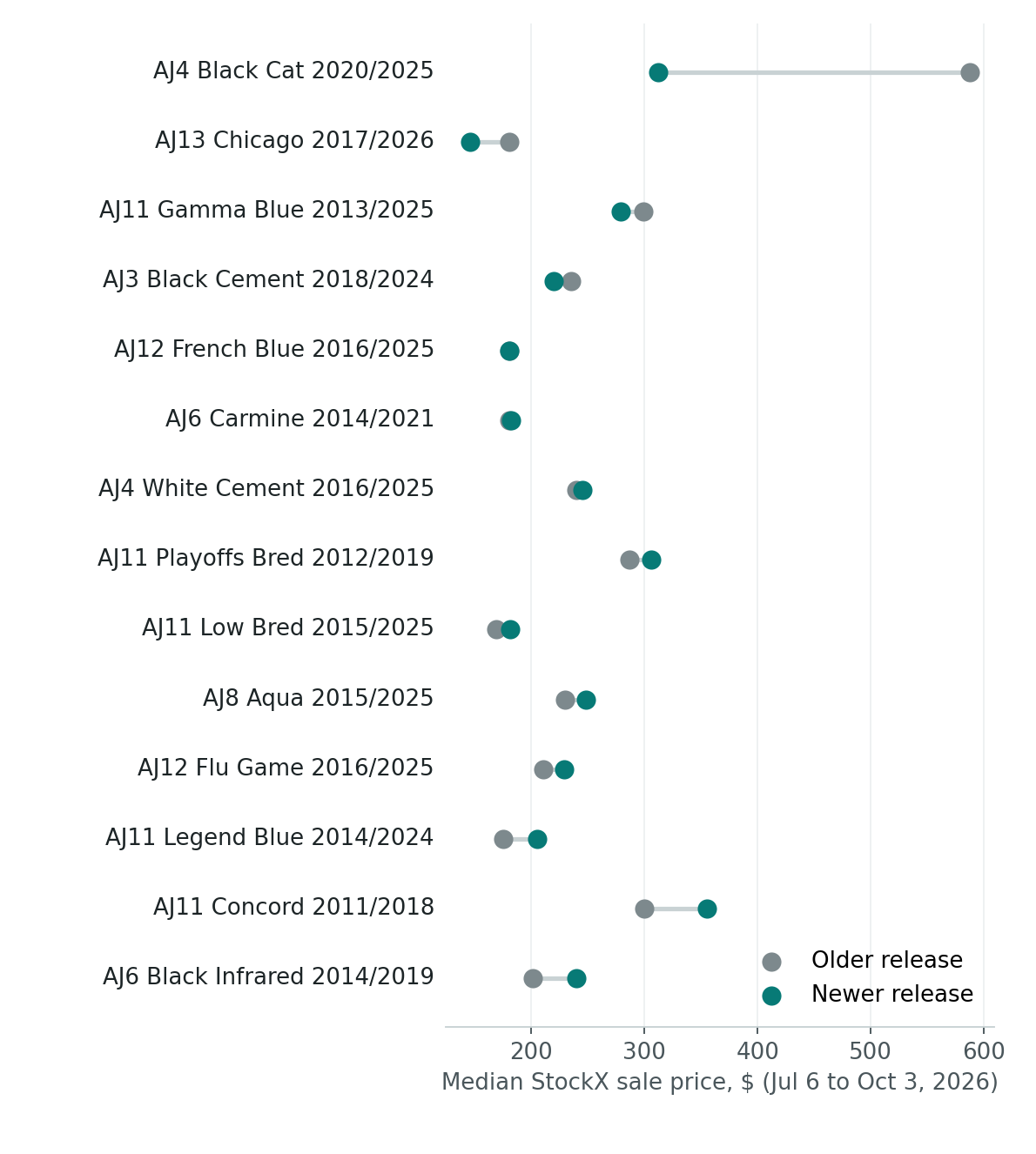
The year usually matters little, with one big exception. In the 14 Jordan colorways we could compare, the older release resold for a median of 96% of the newer one's price, and in 9 of the 14 the two were within 10% of each other. The exception is the Jordan 4 Black Cat: the 2020 pair sold for a median $587.50 against $312 for the 2025 pair.
Look at the tag inside the tongue
The size tag stitched inside the tongue lists the style code and a production date. The style code is the number to search, not the shoe's name, because the name stays the same from one re-release to the next.
StockX adds the release year to the name once a colorway has been re-released, and in our listings the code changes with every re-release. Take the White Cement 4: the 2016 pair is 840606-192 and the 2025 pair is FV5029-100. The Jordan 11 Gamma Blue is 378037-006 from 2013 and CT8012-047 from 2025. In all 14 colorways below, the older and newer releases have different codes. So if you search a name and see two or three results, match the code on your tag to pick the right one.
The production date on the tag is when your pair was made, which is close to, but not always the same as, the year it was released. If the date and the code point to different years, trust the code.
The same colorway, a different year
These are the colorways we could compare most cleanly. Each has two releases that each sold 30 or more pairs on StockX in the 90 days from July 6 to October 3, 2026. Prices are medians. StockX sells new pairs only.
| Colorway | Older year | Older median (sales) | Newer year | Newer median (sales) |
|---|---|---|---|---|
| Jordan 4 Black Cat | 2020 | $587.50 (100) | 2025 | $312 (6,553) |
| Jordan 13 Chicago | 2017 | $180 (45) | 2026 | $146 (2,730) |
| Jordan 3 Black Cement | 2018 | $235 (159) | 2024 | $220 (1,745) |
| Jordan 4 White Cement | 2016 | $240 (133) | 2025 | $245 (4,082) |
| Jordan 11 Bred (Playoffs) | 2012 | $286.50 (48) | 2019 | $306 (745) |
| Jordan 11 Concord | 2011 | $300 (39) | 2018 | $355 (544) |
| Jordan 12 Flu Game | 2016 | $210.50 (72) | 2025 | $229 (835) |
| Jordan 11 Legend Blue | 2014 | $175 (49) | 2024 | $205 (1,566) |
The other six pairs are in the chart. Sales are completed StockX sales, $20 to $30,000. The 2011 Concord has "23" on the heel and the 2018 has "45", so even a same-colorway pair differs in a detail. The 2025 and 2026 releases are still in their launch window, so their medians carry launch-period pricing.
Across 14 colorways, the older release's median price was 96% of the newer one's.
How big the gap usually is
For each of the 14 pairs we divided the older release's median price by the newer one's. The median of those ratios is 0.96, and the 95% interval, from resampling the 14 pairs 20,000 times, runs from 0.92 to 1.04. In plain terms: a typical older pair sold about 4% below the newer one, and the data cannot rule out no difference at all.
The older year sold higher in 4 of the 14 pairs, was equal in one (the Jordan 12 French Blue, $180 both) and lower in nine. Setting the tie aside, that is 4 of 13 (31%, interval 13% to 58%). An exact test against a coin flip gives p = 0.27, so we cannot say older pairs are cheaper or dearer as a rule. The two that sold well above their reissue were the Black Cat 4 (ratio 1.88) and the 2017 Chicago 13 (1.23). The 2011 Concord, the 2014 Legend Blue and the 2014 Black Infrared sold about 15% below the reissue.
Two reasons to be careful. The older pairs have far fewer sales (36 to 159) than the new ones (294 to 6,553), so their medians are noisier. A median across all sizes can hide a size mix: we did not match sizes. And the newest releases (2025 and 2026, such as the Chicago 13) are still in their launch window, so their medians carry launch pricing.
What about the original 1985 pairs?
They barely show up. StockX product names carry the release year, and across all our sales since October 2024 only one Jordan listing is a 1985 release, with one recorded sale. Names with a year before 2000 total 19 listings and 80 sales. Between 2000 and 2011 there are 152 listings and 3,144 sales. In the window, the only listing from before 2012 with 30 or more sales is the 2011 Concord 11, with 39.
That means we cannot tell you what a true 1985 Air Jordan 1 is worth from this data. A pair that old is closer to a collectible than a standard sale, and its price depends on condition and authentication in ways a median cannot show. Check the year against the tag, then look at what recent comparable pairs actually sold for.
How to check your own pair
Search the style code from your tag in our sneaker price checker. If you only have the name, add the release year to separate reissues. Our model pages show how each line has sold: the Air Jordan 1, Air Jordan 4 and Air Jordan 11.
How we measured this
Methodology: completed StockX sales recorded by SneakerPulse, whole UTC days from July 6 to October 3, 2026 (90 days), sales between $20 and $30,000, footwear only, excluding kids', women's and cleat listings. Pairs are StockX Jordan listings whose name includes the release year; each listing needed 30 or more sales in the window, and each colorway contributes one pair, the oldest and newest release years that met that bar. Two colorways sold under different names in different years (the Jordan 11 Bred as "Playoffs" in 2012, the Jordan 6 Black Infrared as "Infrared Black" in 2014) and were matched by hand. The ratio is older median divided by newer median; its interval is a percentile bootstrap over the 14 pairs (20,000 resamples). The share where the older year was higher drops the one tied pair (equal medians) and uses an exact two-sided binomial test and a Wilson interval on the 13 that remain. StockX sells new pairs only; GOAT also sells used pairs and does not put the year in its product names, so we used StockX for the comparison. As a check, the Black Cat 4 style codes also have 30+ sales on GOAT: 2020 median $520.50 (118 sales) vs 2025 $335 (4,225), the same direction as StockX; no other pair had both style codes on GOAT with 30+ sales. Some well-known reissues are not in the sample because StockX gives the newer release no year in its name (Jordan 1 Chicago Lost and Found, the Reimagined Bred 4 and Black Cement 3), or because the two releases differ in a detail (Jordan 5 Fire Red black vs silver tongue; Jordan 1 Bred '85 cut vs the 2016 Banned). We left those out rather than call them the same shoe. Medians are across all sizes. Counts of older-year listings and sales cover all StockX sales on record since October 2024. Style-code examples come from our product table; what the tag contains is general knowledge, not something we measured from sales data.
Keep reading
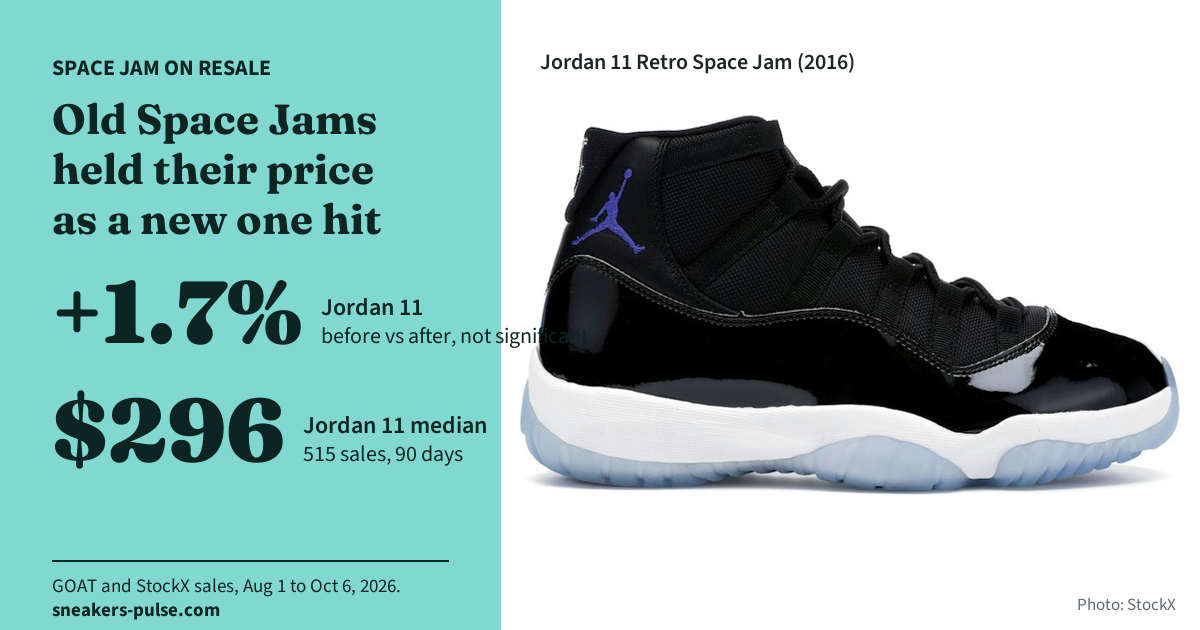 What are Space Jam sneakers worth? The old Jordan 11s resell for about 1.4x retailOctober 8, 2026 — 4 min read
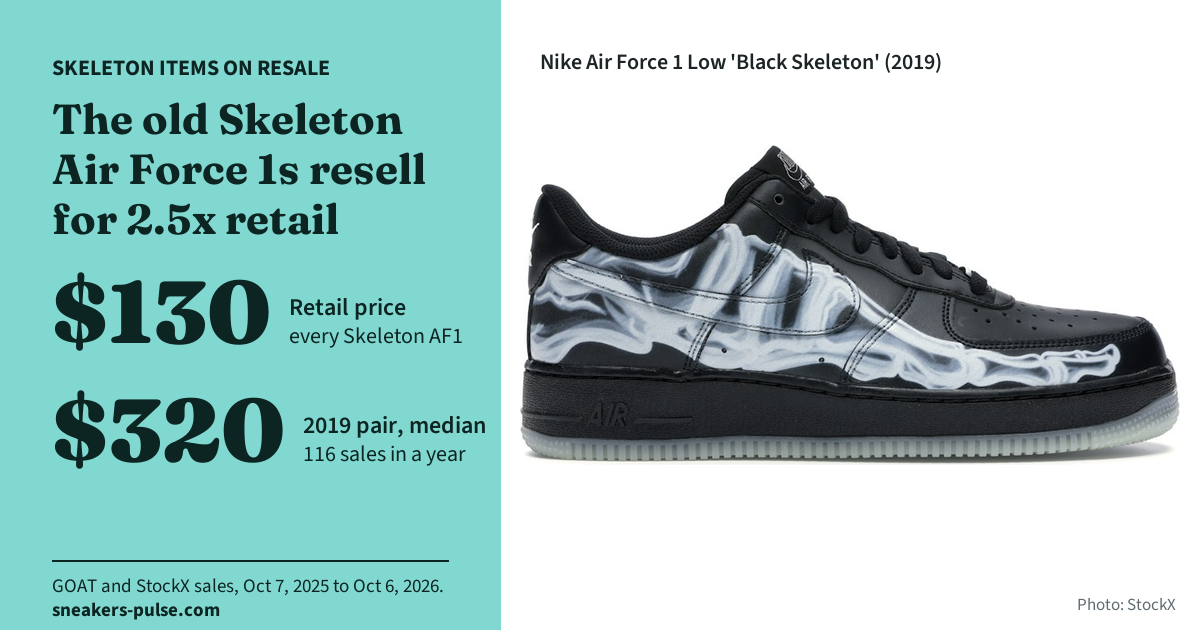 How much do Skeleton sneakers go up? The old Air Force 1s grew about 14% a yearOctober 8, 2026 — 5 min read
 Halloween sneakers on resale, what they cost and whether they sell more in OctoberOctober 8, 2026 — 6 min read