The Bad Bunny effect - what the Super Bowl did to his adidas sneakers on the resale market
After his Super Bowl LX halftime show, sales of Bad Bunny's adidas collabs on GOAT and StockX ran 81% ahead of comparable adidas shoes for two weeks, then faded. His BadBo 1.0 went from $231 to below its $160 retail. A controlled event study.
In one week Bad Bunny won Album of the Year at the Grammys (February 1, 2026) and headlined the Super Bowl LX halftime show (February 8), where he debuted his first signature adidas shoe, the BadBo 1.0. His earlier adidas collaborations, from the Gazelle Indoor "Cabo Rojo" to the Campus and Ballerina, were already trading on the resale market. So did the world's biggest stage move them?
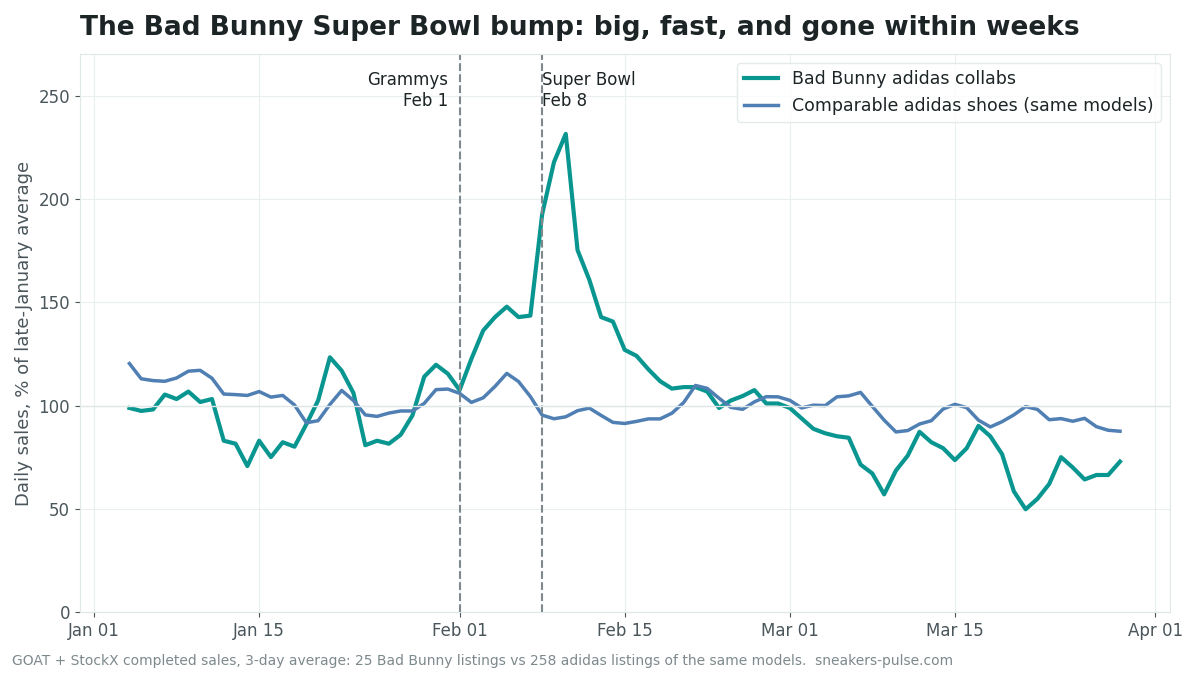
It did, sharply and briefly. In the two weeks around the two events, resale sales of his adidas collabs ran 81% ahead of comparable adidas shoes, and most of that came in the days right after the Super Bowl.
How we measured it
A before-and-after look at one shoe cannot separate a celebrity moment from everything else going on, such as the usual slump after the holidays. So we compared two groups over the same dates:
- Bad Bunny collabs: 25 GOAT and StockX listings of his adidas shoes that were on sale before December 2025 (the new BadBo is treated separately below).
- Comparison group: 258 listings of other adidas shoes from the same model families (Gazelle, Campus, Response CL, Ballerina, Forum, Adizero SL 72, Taekwondo, Samba), with Yeezy excluded.
For each listing we compared its daily sales and its own median price in each window with the eight weeks before the Grammys (December 7 to January 31). The effect is the difference between the two groups' changes. We fixed the windows before looking at the results, and we ran the same test on a fake event date, January 4, as a check that the method does not find effects where there are none.
Results
| Window | What changed | Bad Bunny vs comparison | 95% interval | p |
|---|---|---|---|---|
| Feb 1-14 (both events) | Sales volume | +81% | +59% to +107% | 0.0001 |
| Feb 1-14 | Price | +7% | +2% to +13% | 0.035 |
| Feb 15-Mar 14 | Sales volume | +10% | -4% to +25% | 0.46 |
| Feb 15-Mar 14 | Price | +15% | +10% to +21% | 0.0001 |
| Fake event, Jan 4-17 | Sales volume | -4% | -20% to +14% | 0.74 |
| Fake event, Jan 4-17 | Price | +6% | +1% to +10% | 0.08 |
Sales volume is the clean result. Through the event fortnight his collabs sold 12% more per day than in the baseline, while the comparison group fell 39% as post-holiday demand dropped off. The fake event date shows nothing, which is what we want from the check. The effect had faded by the second half of February, and by mid-March his collabs were selling below their January pace.
The Super Bowl, not the Grammys, did most of the work. On Monday, February 9, the day after the halftime show, his collabs sold 3.1 times their late-January daily average; the comparison group sold 0.94 times its own. After the Grammys the lift was modest: 1.04 times on February 1 and 1.15 times on February 2, building to 1.3 to 1.6 times through that week.
Price needs more care. His collabs' prices rose 7% more than the comparison group's over the event fortnight and 15% more in the following month. But the fake-event check found them already rising about 6% faster than comparable shoes in early January, before either event. The honest reading: prices kept climbing after the Super Bowl, faster than before, but part of that was a trend already under way.
The BadBo 1.0: from hype premium to below retail
The BadBo 1.0 in white, the pair he wore on stage, released the day after the game at $160 and is not in our data. An earlier BadBo 1.0 colorway, "Resilience", is, and it shows how fast a launch premium can go:
- February 2026: a median of $231 on GOAT across 1,007 sales (middle half $216-$247), and $225 on StockX across 2,300 sales, about 44% over the $160 retail.
- March to June: $204, then $189, then about $167 on GOAT.
- August and September: $150.50 and $152, below retail, on 44 and 21 GOAT sales.
StockX recorded only 38 sales of this pair in March (median $202.50) and none after that in our data, so the later months are GOAT only.
What this means
A celebrity moment this big moves resale volume fast, but the effect in our data lasted about two weeks. If you are selling a pair tied to a moment like this, the data says the window is short; our best time to sell tool shows the same decay for new releases generally. If you are buying, waiting a few months has been the better move for the BadBo so far. Check any pair's recent sold prices in the sneaker price checker, and see the wider adidas resale picture.
How we measured this
Methodology: completed GOAT and StockX sales, November 2025 to March 2026. Listings needed at least 30 sales in the baseline; price comparisons also needed 5 sales in the window. Volume change is the log ratio of average daily sales (with half a sale added so a zero window stays defined); price change is the log ratio of window median to baseline median; results are converted to percentages. 95% intervals come from 10,000 bootstrap resamples of listings, and p-values from 10,000 random reassignments of which listings count as Bad Bunny. BadBo "Resilience" figures are monthly GOAT and StockX medians, January to September 2026. Event dates: Grammys February 1 and Super Bowl LX February 8, 2026; BadBo 1.0 retail price from launch coverage.