How to pay less for sneakers on resale: the sizes, weeks and timing where the same shoe sold for less
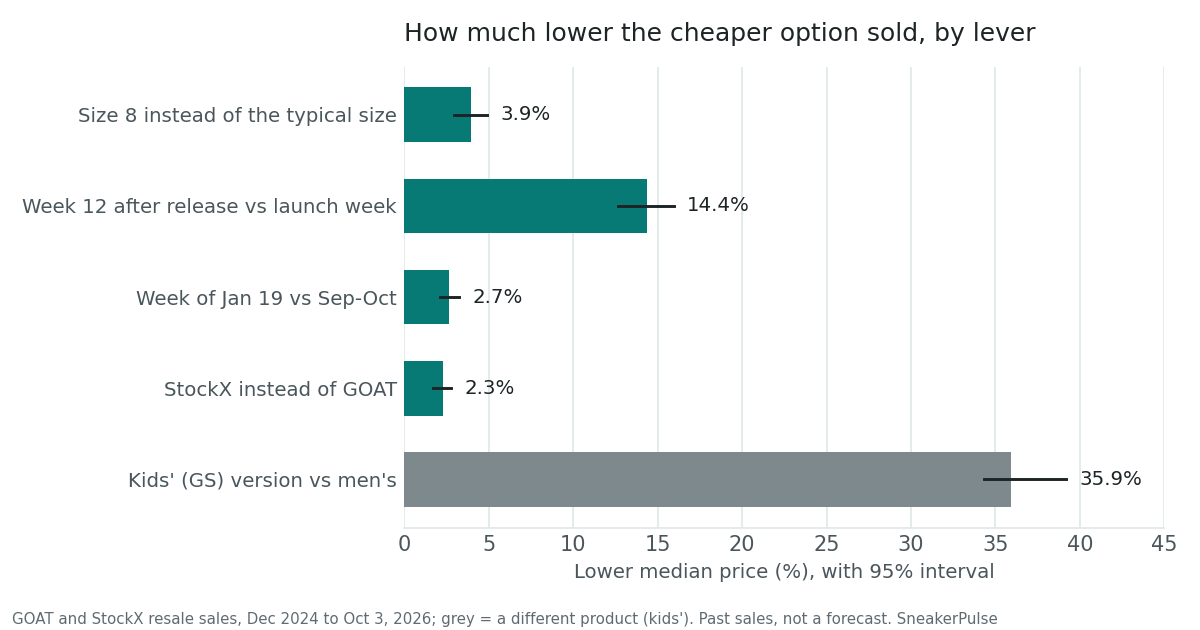
Five things people try to get a cheaper pair. On the same shoe, size, season and marketplace were worth 2% to 4% and waiting a few months after release about 14%. Kids' (GS) pairs, a different product that retails lower, sold 36% below the men's version.
Everyone selling a hyped pair says the price is firm, and everyone buying one wants to know when it drops. The advice online is mostly folklore: buy on Tuesdays, wait for January, never pay launch week.


We tested five of those ideas on resale sales, each time comparing the same shoe with itself so a cheap model can't pass for a cheap lever. All five showed a lower price in the data, but they are not the same size. Waiting after release was the big one, and being a size 8 helps a little. Kids' pairs look biggest, but they are a cheaper product, not a discount on the same one. These are things that happened in past sales, not promises about the next pair.
| Lever | Median price gap | Sample | Window |
|---|---|---|---|
| Size 8 (vs shoe's typical price) | 3.9% [2.9, 4.9] | 772 shoes, GOAT | Jun 30 - Sep 27, 2026 |
| Week 12 after release (vs launch week) | 14.4% [12.6, 16.0] | 1,435 shoes | Launches Dec 2024 - Mar 2026 |
| Week of Jan 19 (vs Sep-Oct) | 2.7% [2.1, 3.2] | 5,498 shoes | Sep 2025 - Feb 2026 |
| StockX instead of GOAT | 2.3% [1.7, 2.8] | 1,591 style codes | Jul 6 - Oct 3, 2026 |
| Kids' (GS) version vs men's (different product) | 35.9% [34.3, 39.2] | 288 colorways | Jul 6 - Oct 3, 2026 |
Median across shoes, 95% interval in brackets. Every row has q < 0.001, meaning it survives testing all five at once. The GS row compares two different products (kids' pairs retail lower); the marketplace row is not size-matched and GOAT includes used pairs; the release row's launch week is the first week with 20+ sales, so part of that gap is the launch peak fading.
Smaller sizes sold for a bit less, and 8 to 9 is the cheapest stretch
In our size curve study, a men's size 8 sold 3.9% below the same shoe's typical price on GOAT (493 of 717 shoes cheaper in that size). Size 9 was 2.2% below. From 10.5 up the same shoe sold for more, reaching 33% more in a size 15.
So the cheapest sizes are 8 and 9, but not by much. If you wear a 12 or 13, you are paying a premium, and no trick on this list closes it.
Waiting after release is the biggest lever
Prices were highest in the first weeks. For 1,828 shoes that launched between December 2024 and March 2026, we compared each week's median price with the shoe's launch week:
- Week 1: 4.1% lower (1,813 shoes)
- Week 4: 9.6% lower (1,693 shoes)
- Week 12: 14.4% lower [12.6, 16.0] (1,435 shoes, 1,064 lower and 365 higher)
- Week 26: 19.5% lower (1,148 shoes)
The typical newly released pair sold about 14% below its launch-week price by week 12.
The drop kept going through the 26 weeks we followed rather than falling off a cliff. Some shoes rose: in 365 of 1,435, week 12 was higher than launch. This points the same way as the best time to sell tool, which runs the same test on 43 chosen models, and it is a pattern, not a rule. One caution: launch week is defined as the first week with 20 or more sales, which tends to catch the busy peak, so part of the drop is that peak fading.
The calendar moved prices only a few percent
For a fixed panel of shoes through the 2025 holidays (see our holiday planning guide), the same shoe sold for 2.9% more in the week of December 15 than in September and October. The lowest week was January 19, at 2.7% below the fall level. In late October it was 1.6% below.
That is one season, so it is a single observation of a pattern, and the swing from the December high to the January low is under 6%. Day of week mattered even less: across the 43 models in our best time to sell tool, the best and worst days differ by 0.8 percentage points on the same shoe. Payday did not help either. In our payday story, the three days from the 1st showed a same-shoe price change of +0.4% (q = 0.12, not significant).
StockX sold the same shoe for a little less than GOAT
For 1,591 style codes with 30 or more sales on both marketplaces, from July 6 to October 3, 2026 (whole days), StockX's median price was 2.3% below GOAT's [1.7, 2.8]. GOAT was higher on 930 codes and lower on 623.
Two limits. Our sales data has no size for StockX, so sizes could not be matched, and GOAT also sells used pairs. And the price you pay includes fees and shipping that vary by order, which this does not count. Treat 2% as a reason to check both sites, not to pick one.
Kids' sizes sold for about a third less, if your foot fits
If you wear a size small enough for grade school (GS) pairs, which stop at 7Y, this is the one that matters. For 288 colorways with a GS and a men's version, 30 or more sales each on the same marketplace, the GS pair's median price was 35.9% lower [34.3, 39.2] from July 6 to October 3, 2026. It was lower for 282 of the 288.
For instance, on GOAT the GS Air Jordan 4 'Toro Bravo' (2026) had a median of $136 against $171 for the men's pair (2,271 and 11,388 sales). On StockX, the GS Jordan 4 Black Cat (2025) had a median of $238 against $312 (2,036 and 6,553 sales).
This is not a discount on the same product: kids' pairs retail for less in the first place. It also only helps people who can wear them.
What it means if you are buying
In past sales, the weeks right after release were when the same shoe sold for the most, while the marketplace and the time of year mattered much less than people assume. Before you pay, check what a pair recently sold for in the price checker, or open the shoe's own page, such as the Air Jordan 4, to see its price by size.
How we measured this
Methodology: GOAT and StockX completed sales recorded by SneakerPulse, footwear only, men's and GS listings as stated (PS, TD, women's and cleats excluded), sales between $0 and $30,000. Each lever compares a shoe with itself and reports the median ratio across shoes with a 95% bootstrap interval (2,000 resamples) and an exact sign test (shoes lower vs higher, ties dropped); the five levers' p-values were corrected together with Benjamini-Hochberg and all have q < 0.001. Size: GOAT, June 30 to September 27, 2026, 772 sneakers with 100+ pairs sold in size 8, size median over the shoe's pair-weighted median (size curve post). Release: shoes whose launch week (first week with 20 or more sales) fell from December 16, 2024 for StockX and February 24, 2025 for GOAT (GOAT sales begin December 28, 2024, so earlier first weeks are not launches) to March 30, 2026, whose first sale was within 60 days before it and whose release year is 2024 or later or unknown, all footwear on both marketplaces (the tool uses 43 chosen models; this uses all 1,828 eligible shoes); each later week's median (5+ sales that week) divided by the launch-week median; shoes with no qualifying week are missing from that week, so later weeks cover fewer shoes. Season: fixed panel of shoes with 3+ sales in August 2025 and in early February 2026, week median over the shoe's September-October median, tested and corrected across 24 weeks (holiday post). Marketplace: SKUs normalised and matched, 30+ sales each side, July 6 to October 3, 2026 (90 whole days), median of the GOAT/StockX ratio of median prices; StockX has no size and GOAT includes used pairs. GS: GS listings matched to the same name without "GS" on the same marketplace (159 StockX and 129 GOAT matches), same window and sales threshold; GS pairs retail lower and are sold in smaller sizes, so the gap is not a like-for-like discount. Sales cluster around releases and one shoe can appear on both marketplaces, so intervals are somewhat optimistic. This describes past sales and is not a forecast or advice.
Keep reading
 Which sneaker sizes run short? Resale prices point to the big sizesSeptember 28, 2026 — 6 min read
 Has the sneaker resale market imploded? The same shoes went from 7% up to 7% downOctober 6, 2026 — 5 min read
 Where should I sell my sneakers? StockX vs GOAT vs eBay, by what you actually keepOctober 6, 2026 — 6 min read