Do NBA stars' big games sell their sneakers? We tested 15 signature athletes
We lined up two seasons of game logs against two years of resale data. Scoring, winning and even missing the season barely moved a player's shoes. Ja Morant's line outsold everyone's while he played 20 games.
The theory sounds obvious. A player drops 40, his team goes on a run, highlight clips flood your feed, and suddenly everybody wants his shoes. Brands build whole marketing calendars around it.
So we tested it. We took 15 NBA players with their own signature sneakers, pulled every game they played across the 2024-25 and 2025-26 seasons, and lined that up month by month against what their shoes did on GOAT and StockX.
The answer: on the resale market, big games don't move the shoes. Not scoring, not winning, not even missing an entire season.
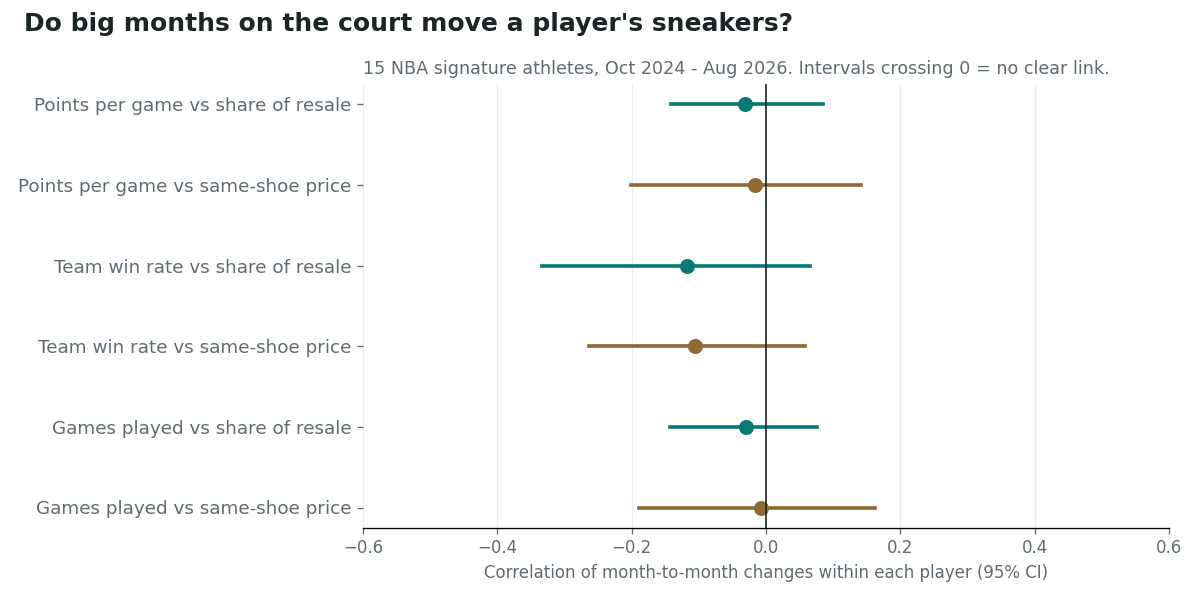
Better months on the court, same months for the shoes
For each player and each month of the season, we measured three things on the court: points per game, how often his team won in the games he played, and how many games he played. On the shoe side we measured two: his line's share of all sneaker resale that month, and a same-shoe price index that compares each shoe with itself the month before.
Then we asked whether a player's better-than-usual months came with better-than-usual months for his shoes.
They didn't. Across roughly 150 to 230 player-months per test, every correlation sat close to zero:
- Points per game vs share of resale: -0.03 (95% range -0.14 to +0.09)
- Team win rate vs share of resale: -0.12 (-0.33 to +0.07)
- Games played vs share of resale: -0.03 (-0.15 to +0.08)
- The same three against same-shoe prices: -0.02, -0.11 and -0.01, all ranges crossing zero
We also checked whether the effect shows up a month later, when the hype might reach buyers. The one number that looked interesting went the wrong way: more points one month, slightly lower resale share the next (-0.20). Across all 12 tests it doesn't survive the standard correction for testing many things at once (q = 0.37, where anything above 0.05 means "could easily be chance").
A player's best month on the court looks, to the resale market, like any other month.
The biggest resale line belongs to a player who barely played
The season totals make the same point without any statistics.
| Player | Games, 2025-26 | Points per game, 2024-25 | Pairs resold, Oct 2024 - Sep 2026 |
|---|---|---|---|
| Ja Morant | 20 | 22.8 | 178,906 |
| Kevin Durant | 83 | 25.2 | 110,003 |
| LeBron James | 63 | 23.9 | 92,419 |
| Anthony Edwards | 67 | 27.3 | 62,069 |
| James Harden | 73 | 22.1 | 50,510 |
| LaMelo Ball | 78 | 24.4 | 50,218 |
| Kyrie Irving | 0 | 23.5 | 45,790 |
| Devin Booker | 72 | 25.2 | 38,725 |
| Shai Gilgeous-Alexander | 71 | 31.2 | 33,940 |
| Luka Doncic | 67 | 28.2 | 8,772 |
Ja Morant's line resold more pairs than anyone's, nearly 179,000, while he played 20 games in 2025-26. Kyrie Irving didn't play a game that season and his shoes still traded almost 46,000 times. Shai Gilgeous-Alexander averaged 31.2 points in 2024-25, the most of any player here, and ranks ninth of 15 for resale.
Across all 15 players, scoring average and resale volume ran slightly opposite (Spearman -0.27), and with 15 players that's well within chance (p = 0.33).
Missing time didn't sink anyone either
Three stars missed an entire regular-season month through injury after playing the month before. Their lines went three different ways: Luka Doncic's share rose 33% in January 2025, Giannis Antetokounmpo's barely moved (+0.6%) in February 2026, and Stephen Curry's dipped 6.5% that same February. Three cases can't prove anything, but they certainly don't show a pattern.
What this means for buyers and sellers
If you're holding a player's shoes and hoping a big playoff run lifts the price, the last two years say not to count on it. On resale, what moves a signature line looks like the shoe itself: the price, the colorway, and whether people wear it off the court.
Why does Ja's line lead, then? We didn't test that here, and price alone doesn't explain it: over the last 90 days his line's median resale was about $117, close to Kevin Durant's ($109) and LeBron's ($119). Our best guess is the shoes themselves, their colorways and who buys them beyond basketball. That's a guess, not a finding.
Want to check a specific pair? Use the price checker, see the top 10 basketball shoes people are buying right now, or read LeBron vs. Jordan: who wins the GOAT debate on resale?
How we measured this
Methodology: Game logs from ESPN's public NBA pages for the 2024-25 and 2025-26 seasons, regular season and playoffs, for 15 players with signature lines (LeBron James, Kevin Durant, Ja Morant, Luka Doncic, Jayson Tatum, Giannis Antetokounmpo, Anthony Edwards, James Harden, Stephen Curry, Devin Booker, Zion Williamson, Shai Gilgeous-Alexander, Kyrie Irving, Damian Lillard, LaMelo Ball). Resale: completed GOAT and StockX sales, October 2024 to September 2026, footwear only, each line matched by shoe name. Only in-season month-to-month changes within each player are compared, never raw levels. Share of resale is the line's sales divided by all footwear resale that month, so market-wide swings and our growing product coverage cancel out. The same-shoe index is the median across shoes of the log change in each shoe's monthly median price (3+ sales in both months). Correlations use player-demeaned changes pooled across players, with p-values from 5,000 circular-shift permutations within each player, 95% ranges from a bootstrap over players, and Benjamini-Hochberg correction across all 12 tests (all q > 0.3). The cross-player comparison is a Spearman rank correlation across 15 players. Our StockX source is missing most best sellers from May 22 to July 3, 2026, which mainly affects volume in those weeks. Past data, not a forecast, and not buying advice.