LeBron vs. Jordan: who wins the GOAT debate on the resale market?
Jordan wins four rounds by knockout, with 87 times the resale volume and a $1,958 grail. But in the one round about holding value, LeBron's shoes are the ones not losing ground.
Every barbershop, group chat and sports-radio call-in show has had the argument: Michael Jordan or LeBron James? Rings, stats, eras, the 1998 Finals against the 2016 comeback. We can't settle that one.
But both men also sell shoes, and the resale market keeps score in dollars. So we ran the debate the only way a sneaker data site can: five rounds, each decided by what people actually paid on GOAT and StockX over the last 90 days.
The short version: Jordan wins four rounds, most of them by a mile. LeBron takes the fifth, and it's the one about holding value.
Round 1, volume: it isn't close
In the last 90 days, 520,349 pairs of numbered Air Jordans resold on GOAT and StockX. LeBron's signature line: 5,995.
That's 87 pairs of Jordans for every pair of LeBrons. It's the difference between a lifestyle icon and a performance basketball line. Jordan 1s, 4s, 5s and 11s are worn every day by people who have never touched a basketball. Most LeBrons are bought to play in, at retail, and rarely resold.
The single most-traded shoe tells the same story. The Air Jordan 5 "Black Carolina / UNC" moved about 8,000 pairs in 90 days on its own, more than the entire LeBron line combined.
Winner: Jordan.
Round 2, price: Jordans cost more to buy secondhand
The median Air Jordan resold for $183. The median LeBron resold for $119.
Part of that gap is retail: Jordan retros launch at $190 to $230, while many LeBron colorways sit on outlet shelves. Part of it is demand. When a LeBron does resell, it's usually a sold-out colorway rather than a hyped one.
Winner: Jordan.
Round 3, depth: 7,220 shoes against 718
Count the different shoes that traded at least once in the window: 7,220 Air Jordans against 718 LeBrons. Jordan's catalog runs from the 1985 Jordan 1 to this year's releases, with kids' sizes to match. 17.5% of Jordan resales were grade-school, preschool or toddler pairs. For LeBron, it was 1.9%.
The Jordan resale market is a whole economy. The LeBron resale market is a handful of shoes.
Winner: Jordan.
Round 4, the grail: $1,958 against $196
Among shoes with at least 50 sales, each line's most valuable pair:
| Line | Most valuable shoe (50+ sales, 90 days) | Median resale | Pairs sold |
|---|---|---|---|
| Air Jordan | Travis Scott x Jordan 1 Retro Low OG SP "Mocha" | $1,958 | 178 |
| LeBron | Nike LeBron 20 "Pink Diamond" | $196 | 177 |
The LeBron 20 "Pink Diamond" is also LeBron's most-traded shoe, which says a lot about how thin that market is. A Jordan collab can resell for ten times what LeBron's best pair does.
Winner: Jordan.
Round 5, holding value: LeBron's shoes aren't losing ground
This is the round that matters if you're buying to keep, or buying to sell later. For every shoe that sold at least five times in both windows, we compared its median price over the last 90 days with its own median over the same 90 days a year earlier. It's the same shoe against itself, so a shift toward cheaper or pricier models can't fake the result.
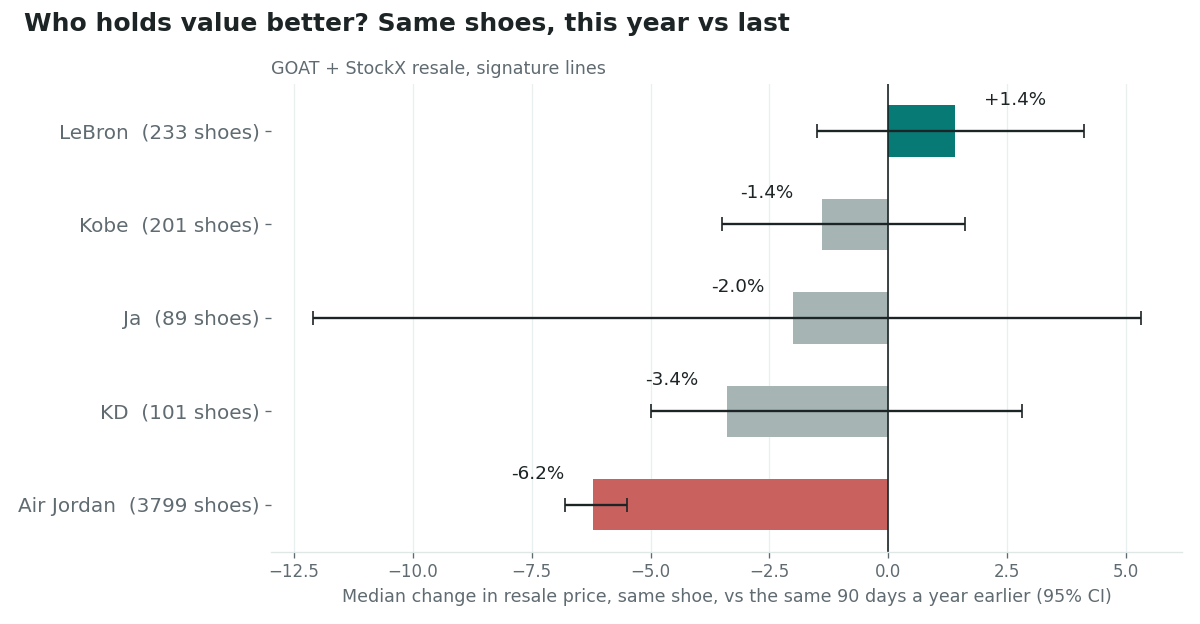
- Air Jordan: -6.2% across 3,799 shoes (95% confidence interval -6.8% to -5.5%). Prices fell on 2,403 of them and rose on 1,348. That's a clear, broad decline, far beyond chance even after correcting for testing five lines.
- LeBron: +1.4% across 233 shoes (interval -1.5% to +4.1%). That's not clearly different from zero, so the fair reading is "held steady". Still, the two intervals don't overlap: LeBron's line did clearly better than Jordan's.
For context, the other big Nike signature lines landed in between, none clearly up or down: Kobe -1.4%, Ja -2.0%, KD -3.4%. Kobe also has the highest median resale price of any line we checked, at $225, above both Jordan and LeBron.
Winner: LeBron.
So who's the GOAT?
On the resale market, Jordan, 4 rounds to 1. There's more of it, it sells for more, and the ceiling is a four-figure collab.
But LeBron's round is a real one. A year of heavy Jordan retro releases has pushed secondhand prices down on most of the same pairs, while LeBron's much smaller market has barely moved. If you're buying Jordans to hold, that 6% slide is the number to know. If you own LeBrons, don't expect to sell above retail, but don't expect the floor to drop out either.
Want the numbers for one shoe? Check any pair in the price checker, browse the Air Jordan resale prices, or see the top 10 basketball shoes people are buying right now.
How we measured this
Methodology: Completed resale sales on GOAT and StockX from June 27 to September 25, 2026 (last 90 days), footwear only. "Air Jordan" is numbered Air Jordan and Jordan models (Jordan 1 to 40, retros and new); "LeBron" is the Nike LeBron signature line (LeBron 1 to 23, Witness, NXXT Gen); collabs that only mention either player on a different silhouette are excluded, as are LeBron- or Kobe-named Jordans. Volume and depth count what our database holds, which covers the most-traded products on both marketplaces, not every sale in existence. Holding value compares each shoe's median sale price in the last 90 days with its own median in the same 90 days a year earlier (at least 5 sales in each), reporting the median change with a bootstrap 95% confidence interval and an exact sign test on how many shoes rose or fell. Benjamini-Hochberg correction across the five lines: Air Jordan q < 0.001; LeBron, Kobe, KD and Ja q > 0.3. Our StockX source is missing most best sellers from May 22 to July 3, 2026, which overlaps the first week of the recent window; it affects volume more than prices. Past sales, not a forecast, and not buying advice.