Where should I sell my sneakers? StockX vs GOAT vs eBay, by what you actually keep
On fees alone eBay leaves the most at $150 and up, and StockX leaves more than GOAT. But the same shoe often sells for a different price on each site, and for 60% of shoes GOAT's price does not make up for its higher fees.
"Which site should I sell on?" starts as a fee question and stops being one when you notice the same shoe does not sell for the same price on both. Then it is two questions: what does each site take, and what does each site's buyer pay?
On fees alone, eBay leaves the most at $150 and up, with StockX second and GOAT third. But across 2,226 shoes sold on both GOAT and StockX, GOAT paid more after fees for only 40% of them. StockX paid more for the other 60%. Which leaves you the most depends on the shoe, not just the site.
On fees alone, eBay keeps the most above $150 and GOAT the least
These come from the schedules inside our resale fee calculator, which we checked against each site's own help pages on September 24, 2026. They assume a US seller in good standing. StockX is at Level 1 (9% transaction fee, $5 minimum, plus 3% processing). GOAT is a prepaid label ($5 seller fee, 9.5% commission) with a 2.9% bank cash-out. eBay is its athletic-shoe rate: 8% at $150 and up, 13.6% plus a $0.40 order fee below that.
| Sale price | StockX | GOAT | eBay (before your label) |
|---|---|---|---|
| $100 | $88.00 | $83.02 | $86.00 |
| $200 | $176.00 | $170.90 | $184.00 |
| $400 | $352.00 | $346.65 | $368.00 |
What you receive after fees, calculator defaults. The calculator's shipping boxes start at $0, so none of these include your own shipping costs.
Two details move the numbers. GOAT drops its $5 seller fee if you drop off the pair, which makes it $87.88 at $100 instead of $83.02. And StockX's rate falls with seller level, to a 7% transaction fee at Level 5. For how StockX's fee waivers change prices, see our look at fee-free days.
The same shoe does not sell for the same price on both
Fees only tell you what comes off a given price. The price is the other half. We matched shoes by style code and kept the 2,226 with at least 30 sales on each marketplace in the 90 days to October 4, 2026.
GOAT's median sale price was above StockX's for 1,282 shoes (57.6%, 95% Wilson interval 55.5% to 59.6%), lower for 870 and identical for 74. The typical gap was +2.3% in GOAT's favor, with the middle half of shoes between -5.0% and +8.4%. Leaving out ties, GOAT was higher for 59.6% (sign test p < 0.001). This fits our earlier finding that the two markets sit close together on average but can disagree on a single shoe: here, 64% of shoes were within 10% of each other (that post used shoes with 10 or more sales each and found 53%; the 30-sale floor here drops the noisiest medians).
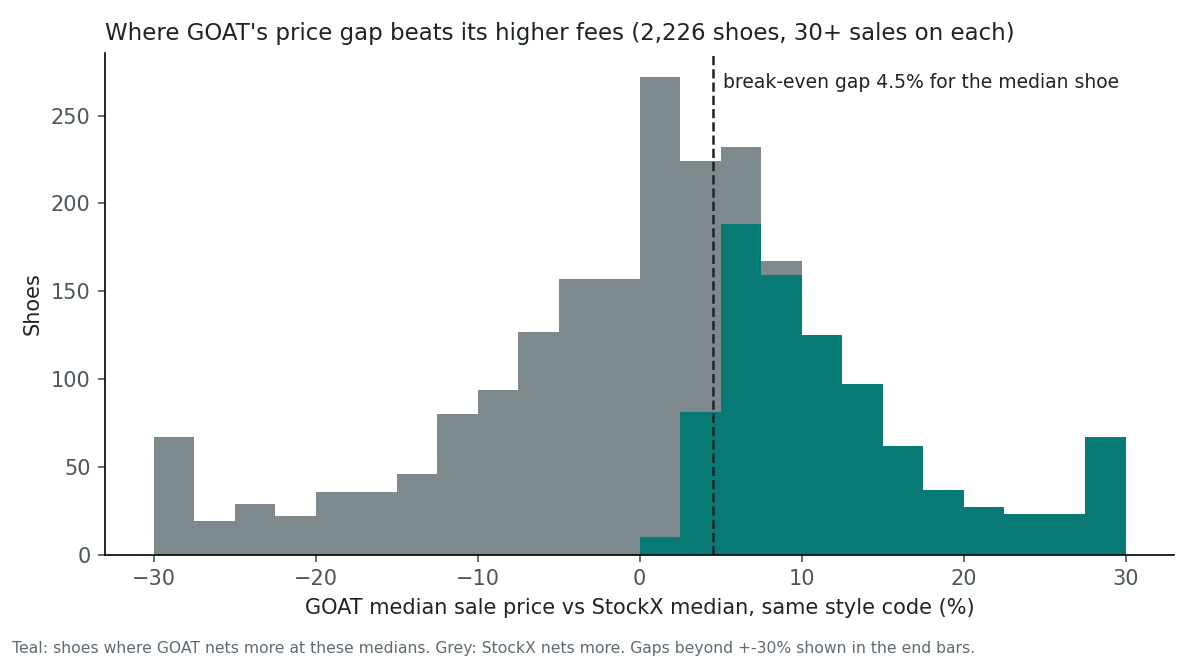
GOAT's median price was higher for 58% of shoes. After GOAT's higher fees, it paid more for 40%.
After fees, StockX pays more for 60% of shoes
At $200, GOAT's fees cost about $5.10 more than StockX's, so GOAT's price needs to run roughly 3% higher just to break even. For the median shoe in this group the break-even gap is 4.5%, because the median shoe here sells for about $126 and GOAT's flat $5 seller fee weighs more on a cheaper pair, and the typical gap was 2.3%.
We applied each marketplace's fees to each shoe's own median price. GOAT paid more for 899 of the 2,226 shoes (40.4%, Wilson interval 38.4% to 42.4%); StockX paid more for 1,327 (59.6%). The median difference was $2.42 per pair in StockX's favor.
It varied with price. By the shoe's StockX median, GOAT paid more for 45% of shoes under $100 (313 of 695), 36% from $100 to $200 (395 of 1,108), 47% from $200 to $400 (170 of 359) and 33% above $400 (21 of 64). Shoes sit in different bands for different reasons, so we would not read a trend into the order.
This is an approximation. It compares medians across all sizes, leaves out shipping, and counts a $1 edge as a win, which is why the StockX or GOAT tool only names a winner when the gap clears normal price noise. GOAT also sells used pairs and StockX only new ones, so one style code can mix conditions.
We can count sales, not days to sell
Not how fast a listing sells. We record completed sales, not listings, so we have no time-to-sell. What we do have is volume: the median shoe had 125 StockX sales against 64 GOAT sales in the window, and StockX had more sales for 1,977 of the 2,226 shoes. That counts the sales we record, not either site's real market share, so we would not turn it into a claim about which is quicker.
For eBay we can price the fees but not the shoe
We model eBay's published fees and nothing else. We have no eBay sale-price data, so we cannot say what an eBay buyer pays for a given shoe. All we can say is that at $200, eBay's 8% rate leaves $184.00 before your own shipping label, against $176.00 on StockX. Whether your pair would sell for that price on eBay is the part we cannot see. The calculator also ignores that eBay charges its fee on shipping and tax too, so the real figure runs slightly lower when the buyer pays shipping.
Three tools answer it for your own pair
- Look up the shoe in the sneaker price checker for what it has recently sold for.
- Run that price through the resale fee calculator with your StockX level and shipping choices.
- Search the shoe in the StockX or GOAT tool to see both sites' medians side by side, after fees.
How we measured this
Methodology: seller fees are the figures in the resale fee calculator (FEES in tools_pages.py, checked against each marketplace's help pages on September 24, 2026): StockX Level 1, 9% transaction fee ($5 minimum) plus 3% processing; GOAT 9.5% commission plus a $5 seller fee with prepaid shipping, then 2.9% of the remainder for a bank cash-out; eBay 8% at $150 and up, 13.6% plus $0.40 below. US sellers in good standing; shipping costs are $0 as in the calculator's defaults, and your own level, standing and shipping will change the figures. Matched shoes come from data/where_to_sell.json, generated October 4, 2026: footwear sold on both GOAT and StockX in the previous 90 days with the same style code (punctuation removed), 30 or more sales on each (the tool uses 20 or more, so its totals differ), sales between $0 and $30,000, medians across all sizes. 2,226 of the file's 3,128 shoes qualified, covering 361,749 GOAT and 693,770 StockX sales. "After fees" applies the fee schedule to each side's median price and compares the two with no allowance for price noise. Intervals are Wilson 95%; the sign test is an exact two-sided binomial against 50%. GOAT also sells used pairs; StockX new only. Sale counts reflect sales recorded by SneakerPulse, not total marketplace activity. Past sales, not a forecast and not financial advice.
Keep reading
 When do UGGs sell the most? UGG resale sales by month, and which year was biggerSeptember 24, 2026 — 5 min read
 NFL sneakers off the field, and do they sell more in football season?October 5, 2026 — 7 min read
 Baseball's sneakers, what Griffey, Jeter and playoff-team pairs sell for on resaleOctober 5, 2026 — 7 min read